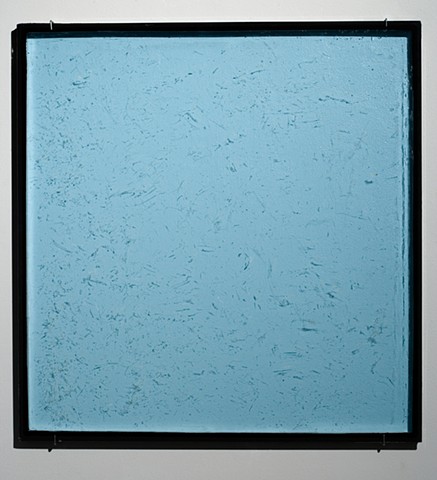
Following the Fault Line
Following the Fault Line emerges from a personal inheritance marked by contradiction. The artist is from a line of water witches on their maternal side, while their paternal grandfather served as a Baptist minister. These traditions reflect paradoxical ways of understanding the world: one grounded in institutionalized religion, and the other in embodied, often taboo practices of sensing. The title, Following the Fault Line, refers both to geological fractures and subtle ruptures that run through faith and our place in it. By tending to these transformations, the work opens contentious spaces for reflection, refusal, and metamorphosis.
In Following the Fault Line, the Bible is subjected to a series of transformations. One was burned in a moon ritual, reflecting renewal and regeneration. Another was drilled and filled with bitumen, a material tied to the petrochemical landscapes that dominate Alberta identity and industry. A third was slathered in honey, reflecting the complex relationships between extractivism and agriculture. The fourth was encrusted in salt that both preserves and erodes. The mineralized salt licks are used for livestock nutrient supplementation and sit alongside pieces that were sculpted by the tongues of deer and cattle. These materials move between geological, ecological, and biological registers. The ash from the Bible is used for a series of lunar drawings. Combined with charcoal and bitumen, the drawings trace the cycle of thirteen moons, following temporal systems that precede the colonial Julian calendar and Christian methods of timekeeping.
Thank you to Franklynn Bartol, Christina Cuthbertson, Ryley Gelinas, Evelyn Hamdon, Bryce Krynski, Rita McKeough, Alissa Overend, Ann Thrale, and Cherry Wood. Installation images courtesy of the Leighton Arts Centre.
Read a review of the exhibition by Levin Ifko here.